What’s the Angle Seat Valve
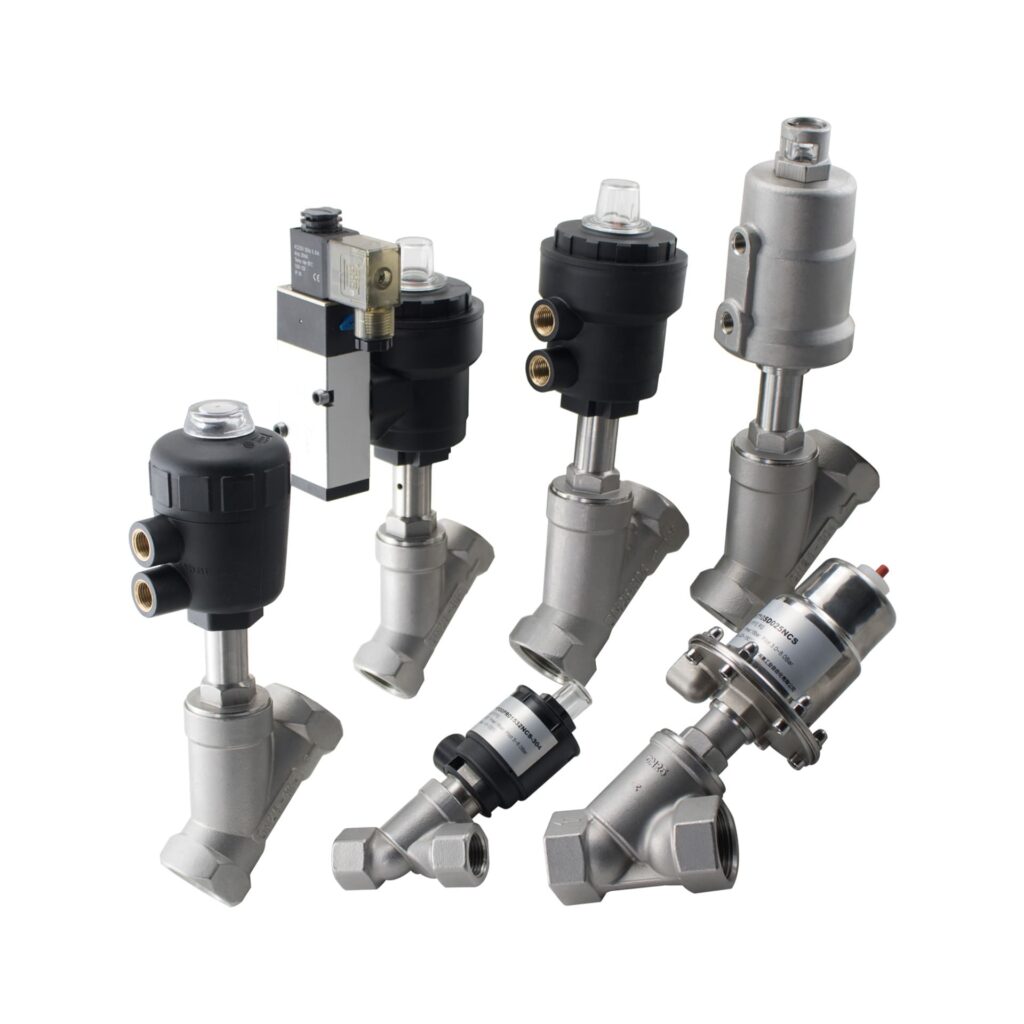
An angle seat valve is a 2/2 ways pneumatically-operated valve with a piston actuator providing linear actuation to lift a sealed piston off it’s seat.The seat is set at an angle die casting valve body to provide the maximum possible flow rate when unseated.The upper part of the angle seat valve is a pneumatic actuator.The actuator structure is similar with a typical air cylinder,with inlet and outlet port.And the on the rod end assembled with sealed piston of the angle seat valve. When the actuator is drived by the air pressure, it’s piston move upward or downward , thus impel the sealed disc of the angle seat valve to open or close through the stem(the piston rod of the cylinder).The return movement of the sealed disc is usually achieved by the spring that can be builted in the pneumatic actuator. In the double-acting configuration, there is no return spring, and the both of the opening and closing action are drived by the compressed air. A red visible dome shape indicator are assembled on the top of the actuator.It’s for checking the pistion of the piston of the actuator, so to judge the state of the angle seat valve, opening or closing .
The Constructure of the angle seat valve:
They share the similar structure with globe valves, but use a piston operated angle seat valve .And the with a closure spring in the single action type. The body is normally cast or die-forged in one piece. The material could be stainless steel or bronze. A plug with a sealed disc pad is connected to the end of the piston which is seated on PTFE seats. The piston is designed to retract further from the seat, thereby providing maximum flow rate. They may be Normally Closed (NC), Normally Open (NO) or Double Acting. The piston actuator comes with threaded ports or with NAMUR ports which allows for direct mounting of NAMUR style solenoid valves.
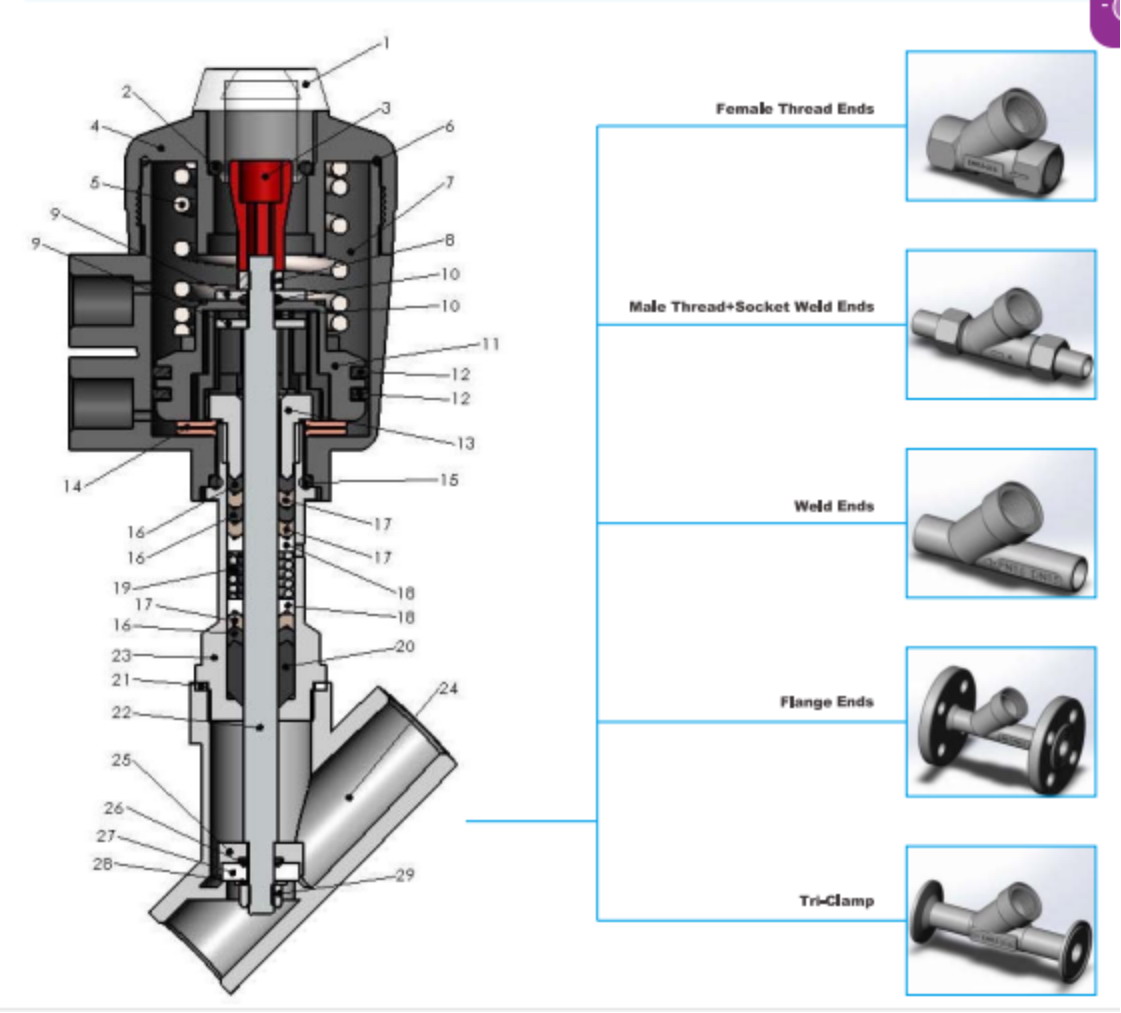
1.Visible Indicator Cap 2.O-ring 3.Visible Indicator Set 4.Actuator Cover 5.Rset Spring 6. O-ring 7.Actuator 8.Screw Nut 9.Fix Pad 10.O-ring 11.Actuator Piston 12.Piston Seal 13.Lock Nut 14.Snap Ring 15.O-ring 16. V-Seal Ring 17. V-Seal Ring 18. Spring Seat 19. Spring 20.Wiper 21. Sealing O-ring 22. Seal Pad 23. Screwed Connector 24. Valve Body 25.Swivel Plate 26.O-ring 27.Sealed Pad Seat 28. Washer 29.Fixed nut Often, the actuator head can be rotated 360° to allow optimum position of air and electric lines in tight locations. Connection types include threaded, clamped or welded. Typically, a visual indicator on the top of the piston shows whether the valve is open or closed. Valve Configurations:
Spring Ret. N.C. Bi-directional Flow: N.C : Normally close That’s the valve which the medium could flow in double direction, from the above sealed plug or from the below sealed plug. It’s the single action actuator controled type. The piston is reset by the Spring.Usually are used in the system which once the air direction valve fail or the power outage happen will not lead to the accidents.
Spring Ret. N.C. Flow from Above Plug N.C : Normally close That’s the valve which the medium could flow from the above sealed plug. It’s the single action actuator controled type.The piston is reset by the spring.Usually are used in the system which once the controling air direction valve fail or the power outage happen the medium must be cut off immediately.Otherwise may cause demage.Such as the oil supply system.
Spring Ret. N.O. Flow from Below Plug N.O : Normally open That’s the valve which the medium could flow from the underneath of the sealed plug. It’s the single action actuator controled type.The piston is reset by the spring.Usually are used in the system which once the controling air direction valve fail or the power outage happen the medium must be supplied unceasingly.Otherwise may cause disaster.Such as in the fire-fighting system.
Double Acting Bi-directional Flow That’s the valve which the medium could flow both direction of the sealed plug. It’s the double action actuator controled type.The piston is reset or drived by the actuator totally.Could be used in many situation if the safety factors is not the important consideration.
Manual Handle Bi-directional Flow The difference with the Double Acting Bi-directional Flow valve is the controling pattern.Not by the actuator, but controlled by manual.
Where the angle seat valve is used ?
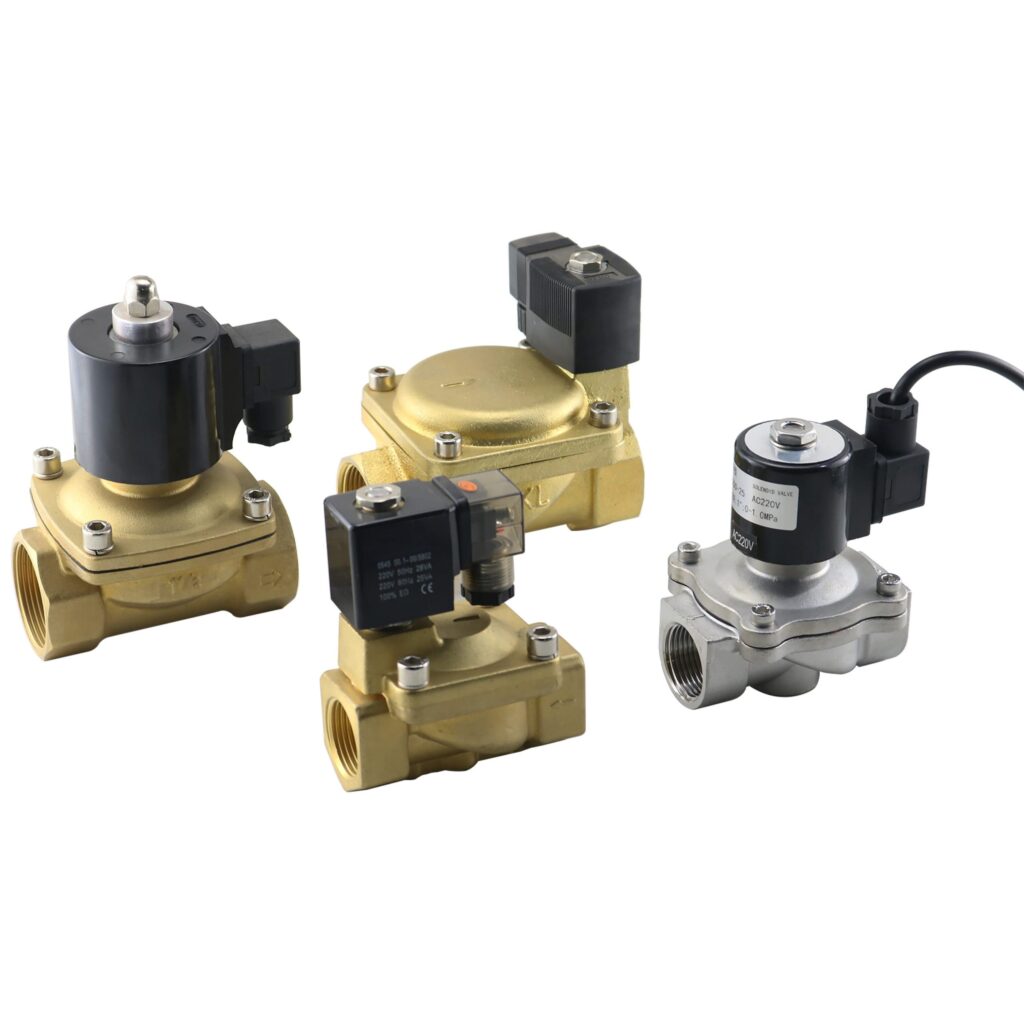
They are used to regulate the flow of liquids, gases, steam, vacuum and even aggressive fluids. They can also operate with high temperatures and high viscosity media, even under zero differential pressures.And if some models are installed reversely will eliminate water hammerin the operation.The robust design makes angle seat valves a popular choice for harsh applications and they have very high cycle lives. Therefore, they are excellent long-life alternatives to ball valves. These valves are also suitable alternatives for solenoid valves, especially with contaminated, viscous media where typical solenoid valves would fail. They may be operated using a single acting or double acting configuration, which has an influence on its pressure rating. They can also be designed as manually operated or electrically operated. Application These valves can be used to deliver millions of cycles of operation in demanding applications such as steam, water and aggressive media. They are ideally suited for vacuum applications and can be used in fast acting applications up to 1000 cycles per hour with expected life of over 10 million cycles. They are used in many industries, including food & beverage, chemical, oil & gas, water & sewage etc.
Operating Temperature, Pressure and material properties
Typically, the maximum working pressure lies in the range of 5 to 20 bar. Not only the pressure of the media has to be taken into account, also the pressure (range) of the compressed air circuit has to be taken into account. They can handle temperatures up to 200 °C using PTFE (Teflon) sealing. Other sealing materials include NBR (Nitrile Buna Rubber), FKM (Viton) and EPDM, which usually have a lower temperature rating. The temperature and pressure rating is also affected by the housing material. Typical housing materials include bronze, 314 or 316 stainless steel, brass, plastic and gunmetal. Of these materials, stainless steel offers the best corrosion resistance and material strength. Therefore, most of the high pressure or high temperature angle seat valves have a stainless-steel housing with PTFE seals. The piston housing can be made of the same material as the valve body, but some have a plastic housing instead to save weight or production costs. Piston Valve Selection Considerations How to choose the angle seat valve:
- Single-acting and double-acting :Single-acting (pneumatic head is usually a hole); working principle; according to the function of spring return to open and close, it is divided into normally open type and normally closed type. Double-acting (pneumatic head usually has two holes); working principle: gas supply controls its switch. 2. Pneumatic angle seat valve can be divided into: stainless steel pneumatic screw (internal thread) angle seat valve, stainless steel pneumatic quick-loading angle seat valve, stainless steel pneumatic flange angle seat valve according to the pipeline installation category. 3. Pneumatic angle seat valve is divided into: all stainless steel pneumatic screw (internal thread) angle seat valve, all stainless steel pneumatic quick-loading angle seat valve, all stainless steel pneumatic flange angle seat valve. 4. Practical application parameters of pneumatic angle seat valve: pressure range: 0-1.6Mpa, medium temperature: -10 ℃ ~+180 ℃, ambient temperature: -10 ℃ ~+60 ℃. 5. Stainless steel pneumatic screw (internal thread) angle seat valve specification: DN15-80, stainless steel pneumatic quick-install angle seat valve specification: DN15-60, stainless steel pneumatic flange angle seat valve specification: DN15-100, all stainless steel pneumatic wire Buckle (internal thread) angle seat valve: DN15-65, all stainless steel pneumatic quick-load angle seat valve: DN15-65, all stainless steel pneumatic flange angle seat valve: DN15-80. 6. Body material: stainless steel. Sealing material: Teflon. Actuator housing: polyamide press, stainless steel. 7. Application of pneumatic angle seat valve in life: control gas: neutral gas, air. Control liquid: automatic industrial control fluid, food grade dairy industry, domestic water, common pipeline fluid medium, etc.
Conclusions
The main advantage of the angle seat configuration is that compared with other valve types it gives a high flow rate with low pressure loss. Other benefits include elimination of water hammer and also resistance to backflow. Hence angle seat valves are an economical alternative to ball valves while providing a longer service life. Various parameters as mentioned above must be considered for the right selection of angle seat valve. The valve material selected must also be compatible with the medium that flows in the valve.