
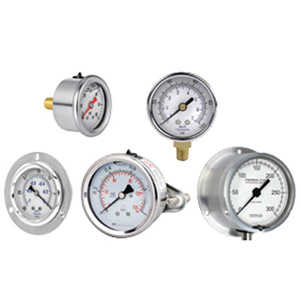
 What Is a Pressure Gauge?
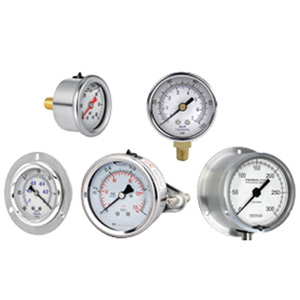
A pressure gauge is an instrument used to measure the pressure of fluids (liquids or gases). It shows the force exerted by the fluid per unit of surface area—typically in units like psi (pounds per square inch) or N/cm² (newtons per square centimetre).
 Types of Pressure Gauges
Pressure gauges vary widely depending on their application, medium, and measurement method. Below are the most common types:
Measures pressure independent of atmospheric pressure.
Useful in applications requiring precise vacuum or absolute pressure readings.
Uses a thin-walled, accordion-shaped metal tube (bellows).
Expands under pressure to move a pointer.
Highly sensitive, ideal for low-pressure applications.
The most common type.
Contains a curved, elastic metal tube sealed on one end.
Pressure causes the tube to straighten slightly; this motion is transferred to a dial pointer.
Suitable for a wide range of pressures and robust industrial use.
Measures the difference between two pressure points.
A diaphragm separates two chambers; pressure differences cause movement.
Commonly used in filter monitoring, flow rate measurement, or level detection.
One of the simplest types.
Uses a U-shaped transparent tube partially filled with liquid (e.g., mercury or water).
One side is open to the atmosphere, the other to the pressure source.
Pressure is read by the height difference of the liquid columns.
A basic form of manometer for medium-pressure liquid systems.
Consists of a straight vertical glass tube open at both ends.
One end is connected to the fluid pipe, the other open to the atmosphere.
The height of the fluid in the tube indicates the pressure.
 Summary Table
| Gauge Type | Best For | Key Feature |
|---|---|---|
| Absolute | Precision/vacuum applications | Ignores atmospheric pressure changes |
| Bellows | Low-pressure systems | High sensitivity |
| Bourdon Tube | General industrial use | Durable and widely used |
| Differential (DP) | Comparing two pressure points | Diaphragm movement |
| Manometer | Simple, low-cost applications | Measures fluid column height |
| Piezometer | Medium-range liquid pressure | Simple glass tube display |
Pressure is defined as the force applied per unit area. It describes how much force is acting on a surface.
 Pressure Formula
p: Pressure
F: Force (in Newtons)
A: Area (in square meters)
| Unit System | Unit | Symbol | Equivalent |
|---|---|---|---|
| SI | Pascal | Pa | 1 Pa = 1 N/m² |
| CGS | Barye | Ba | 1 Ba = 0.1 Pa |
| Kilopascal | kPa | 1 kPa = 1,000 Pa | |
| Megapascal | MPa | 1 MPa = 1,000,000 Pa = 1,000 kPa | |
| Gigapascal | GPa | 1 GPa = 1,000 MPa = 1,000,000,000 Pa | |
| Bar | bar | 1 bar = 0.1 MPa = 100,000 Pa = 14.5038 psi | |
| Pounds per square inch | psi | 1 psi = 6,894.76 Pa |
 Definition of Pascal
1 Pascal (Pa) = Pressure from a force of 1 Newton acting on 1 square meter of area.